
Illustrated Encyclopedia of Human Anatomic Variation: Opus III: Nervous System
Ronald A. Bergman, PhD
Adel K. Afifi, MD, MS
Ryosuke Miyauchi, MD
Peer Review Status: Internally Peer Reviewed
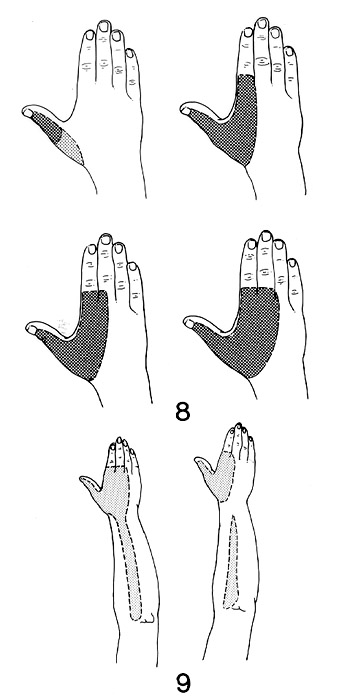 The sensory distribution on the radial side of the dorsum of
the hand is subject to considerable variation. Stopford studied this
problem by examining the distribution of sensory loss after division
of I. the musculospiral (radial) nerve above and below the point of
origin of its lower external cutaneous branch (lower lateral
cutaneous branch); II. the radial at various levels in the forearm;
and III. the musculocutaneous nerve.
The sensory distribution on the radial side of the dorsum of
the hand is subject to considerable variation. Stopford studied this
problem by examining the distribution of sensory loss after division
of I. the musculospiral (radial) nerve above and below the point of
origin of its lower external cutaneous branch (lower lateral
cutaneous branch); II. the radial at various levels in the forearm;
and III. the musculocutaneous nerve.
8: Upper left, the anesthesia is confined to the dorsum of the thumb in most cases, including the dorsum of the first metacarpal bone, but in a few, is restricted to the phalanges.
When the division of the radial occurred above the origin of the lower lateral cutaneous nerve, the anesthesia conformed to the following distribution in 33 cases examined. Upper left, in 13%; upper right, in 13%; lower left, in 16%; lower right, in 58%.
When the radial was severed distal to the origin of the lower lateral cutaneous nerve, the anesthesia conformed to the following distribution in 20 cases. Upper left, in 20%; upper right, in 30%; lower left, in 20%, lower right, in 30%.
When the radial was severed in the forearm, the anesthesia conformed to the following distribution in 7 of 8 cases. Upper left, in 33%; upper right, in 33%; lower left, in 17%; lower right, in 17%.
9: This figure shows the most common pattern of sensory loss in the forearm and hand following division of the radial in the upper third of the arm. Left, area supplied by both the lower lateral cutaneous nerve and the superficial radial nerve; right, where the sensory loss on the hand is more restricted there is a distinct separation of the two nerves.
Redrawn from Stopford, J.S.B. The variation in distribution of the cutaneous nerves of the hand and digits. J. Anat. 53:14-25, 1919.
Section Top | Title Page
Please send us comments by filling out our Comment Form.
Anatomy Atlases is licensed under a Creative Commons Attribution-NonCommercial-ShareAlike 4.0 International License. 
"Anatomy Atlases", the Anatomy Atlases logo, and "A digital library of anatomy information" are all Trademarks of Michael P. D'Alessandro, M.D.
Anatomy Atlases is funded in whole by Michael P. D'Alessandro, M.D. Advertising is not accepted.
Your personal information remains confidential and is not sold, leased, or given to any third party be they reliable or not.
The information contained in Anatomy Atlases is not a substitute for the medical care and advice of your physician. There may be variations in treatment that your physician may recommend based on individual facts and circumstances.
URL: http://www.anatomyatlases.org/